

 Cube Quest
Designed by Oliver and Gary Sibthrope
2 Player Game
Dice Flicking Dexterity Game
Gamewright
Introduction / Background
I am a lover of dice. I am also a big fan of dexterity games like shuffleboard (doesn't mean that I'm necessarily good at them). Oliver and Gary Sibthrope with Gamewright has combined my love of dice with a great dexterity element to create Cube Quest. The simplicity of the gameplay makes the game very accessible to younger kids, while the game has enough strategy and dexterity skill involved to keep older players coming back for more.
 Components / Rule Book
Inside the box, you will find 50 dice (25 for each side), two playing mats (made of a mouse-pad material), an instruction sheet, and a cube/dice reference guide.
Let's start with the rule book (or rule sheet). The instructions for this game are actually all on one side of the the rule sheet and another in-depth cube/dice reference guide about the different dice is included on the back of the the rule sheet. The rules are well explained and easy to understand. The explanations for the different dice are adequate - the game is simple, and so are the rules explaining how to play it.
 The components are nice. I like the mouse-pad type material used for the mats a lot. There has been some issues with some of the mats becoming damaged during packaging as each mat has been folded in half twice to fit into the box. Don't worry though, if you open your box to find creased mats, Gamewright has a very friendly and helpful customer service and I have heard from many who contacted Gamewright and received replacement mats very quickly. They are also sending the replacement mats rolled up instead of folded which has eliminated the possibility of the creases. I contacted Gamewright about this issue, and they are replacing any mats that are damaged and they are looking at a possible re-packaging for the game for future production runs. All this being said, I love the mat material and the mat artwork is nice, but not distracting. For future productions I would think that making the two player mats into a total of eight smaller mats might be best. I'm not sure if having them rolled up in a tube would cause long term warping or not with that material, but smaller mats could do the trick.
 Setup
SetupThe game can be set up in less than a minute. Each player sets up their side at the same time and even thinking strategically, the game is set up very quickly. The game suggests setting up a divider while players arrange their dice, the game box can be used to do this, but you could also set time limits or setup your dice without a divider. Dice can be placed pretty much anywhere; the king must be played somewhere in the castle. You can stack dice up to create walls, or you can spread your dice out across your side of the mat. This flexibility in game set up helps the game have great replayability as you play around with different opening formations.
Gameplay
Players take turns flicking their dice while trying to knock off their opponent's dice from the playing mats. The winner of the game is the player who can knock off the enemy's king first. You can only flick one dice a turn (or use a special dice's ability once). If a dice is partially off the mats, it does not count as being knocked off and can still be in play.
The other key element to the game comes from how your dice lands when on your opponent's side of the playing area. In a normal basic game, each player will have one king, four strikers, and twelve grunts. Each type of dice has a different number of "captured" sides represented on the die. These "captured" sides are represented by a silhouette of that character. Grunts for example, have four "captured" sides, while the striker dice only have one.
 Whenever you flick your dice and it lands in your opponents territory, you must evaluate the status of your dice. If your dice is "captured" side up, then your dice is "captured." You then have the chance of escape by rolling that dice. If it comes up "captured" side again, the dice is removed from play ("destroyed"). If you happen to roll and the dice comes up with one of its "picture" sides, your dice has escaped and is placed somewhere in your castle for future use. So, striker dice are better attackers as they have a much high probability of staying alive in enemy territory, while the grunt dice have a slim chance of surviving long. You start out with many grunts though and they can be sacrificed to an extent (just realize that when you send them over, there is a high chance you won't get them back, so make their attack count).
 As the game progresses, your dice (and hopefully your opponent's) will start to thin. Your king may have been knocked close to the edge of defeat. Well, some of the dice have abilities and your king just so happens to be one of them. Instead of flicking a dice your turn, you can spend your turn to move your king back into your castle. This can be extremely beneficial if your king is teetering on the edge of the mat. Grunts and strikers don't have abilities, but there a few other dice that I haven't mentioned yet.
Each dice has a certain point value associated with it and each player chooses an army of 40 or less points. You can determine if it is more important to you to have as many dice out as you can with lots of "weak" grunts, or you can have some highly specialized dice that can sneak into your opponent's territory, or give you "one-use" abilities to revive removed dice or freeze opponent dice to keep them from attacking. Once players pick their armies from their set amount of dice and points, game progresses just like normal, but players may be playing with dice with special abilities. While the selection or variety of dice isn't huge, it does provide enough to keep things interesting. The reference card and sheet is helpful in determining your armies and evaluating your strategy. The reference shows how many "captured" sides each dice has, the point value of that dice, and the ability associated with that dice if applicable.
You can really make this game your own by slightly modifying rules or change the setup of the game. I suggest playing around with the layout of your mats. The game plays just fine as described in the rules, but think of different ways that you could make the game even more interesting. A few game setup suggestions:
- Instead of setting up your dice with a divider, use a sand timer and set up your dice in real time with a time limit. You will be able to see your opponent's dice and try and counter their plan. It will feel like you are playing football, and you are trying to match the audible just called right before the ball is snapped.
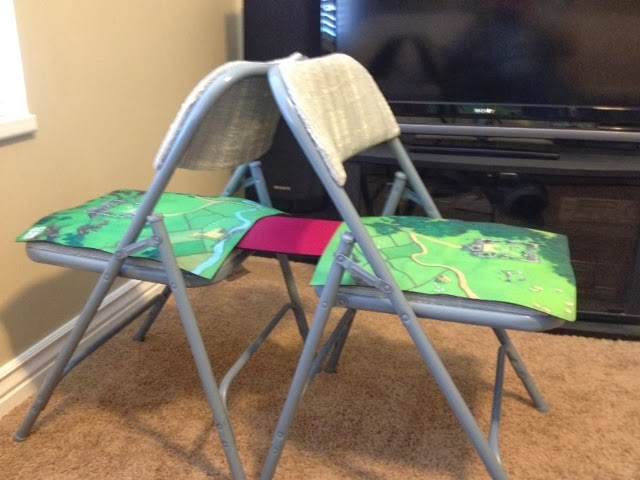
- Move the mats apart by six to twelve inches (or whatever you desire) and place a makeshift "bridge" between your two playing mats. You could make this bridge out of an old mouse pad, or just use paper. You can make the bridge wide or narrow. You can come up with some pretty cool setups! This bridge is considered neutral while no dice are on the bridge, but the bridge becomes part of your territory if you have the majority of dice on the bridge. If a captured side comes up while neutral, nothing happens, but if your opponent controls the bridge, then it is just as if you had landed on your opponent's mat. You can skip your dice across the empty spaces, but your dice must land on a mat or bridge to remain in play. You can make it even more interesting by elevating the two playing mats creating cliffs at the edge of the mats. You can add multiple bridges across the gap etc. In my pictures, you can see one "bridge" scenario where I used a couple of chairs, a TV remote, and a mouse pad to create the "Red Bridge of Death!" All the ends of the mat and the bridge across are slopped towards impending doom!
- Along the same lines as the "bridge" scenario described above, you can place items under your mats to create slight variations in your landscape. You can also place objects on the landscape to create "walls" or other things to impede a direct approach to your opponent.


This is a fantastic dexterity game! I don't have many dexterity games, but this is my favorite one by far. I really enjoy the simplicity of the game, the light plastic dice work perfectly for flicking, and I enjoy the mouse pad type material used for the mats. I feel that the sticker type placement of the pictures on the dice works just fine, although I would have liked to see something done to eliminate the possibility of these to fall off over time (I still think that it is pretty unlikely that you will have any fall of, but it is a worry of mine). I enjoy the fact that you can set up your dice in a huge variety of ways (stacking to form front walls, placing dice behind your king to help keep your king on the mat, or trying to spread your dice out to be hard targets). Similarly, you can play around with the actual landscape or playing area. I'm not suggesting that the game needs all this variation, but you can easily do it and you can create some really fun game scenarios.
The dice abilities are good ones and really do add a nice element to the game. Likewise, you can create your own abilities and use those instead of the ones described in the rules. I might have liked some variation in the artwork for each side to further differentiate the dice from one another, but the artwork for the game is good. I really could see a possible expansion for the game creating a "bridge" scenario and a few new dice. The setup time and time to learn the game is very fast and the game time is quick too. This would be a great game to check out for all you Casual Gamers out there! I am giving Cube Quest 3 fingers up, or 8 out of 10 stars.You will want to play again and again and that is How Lou Sees It!
A big SHOUT OUT to Gamewright games for making this review possible!


